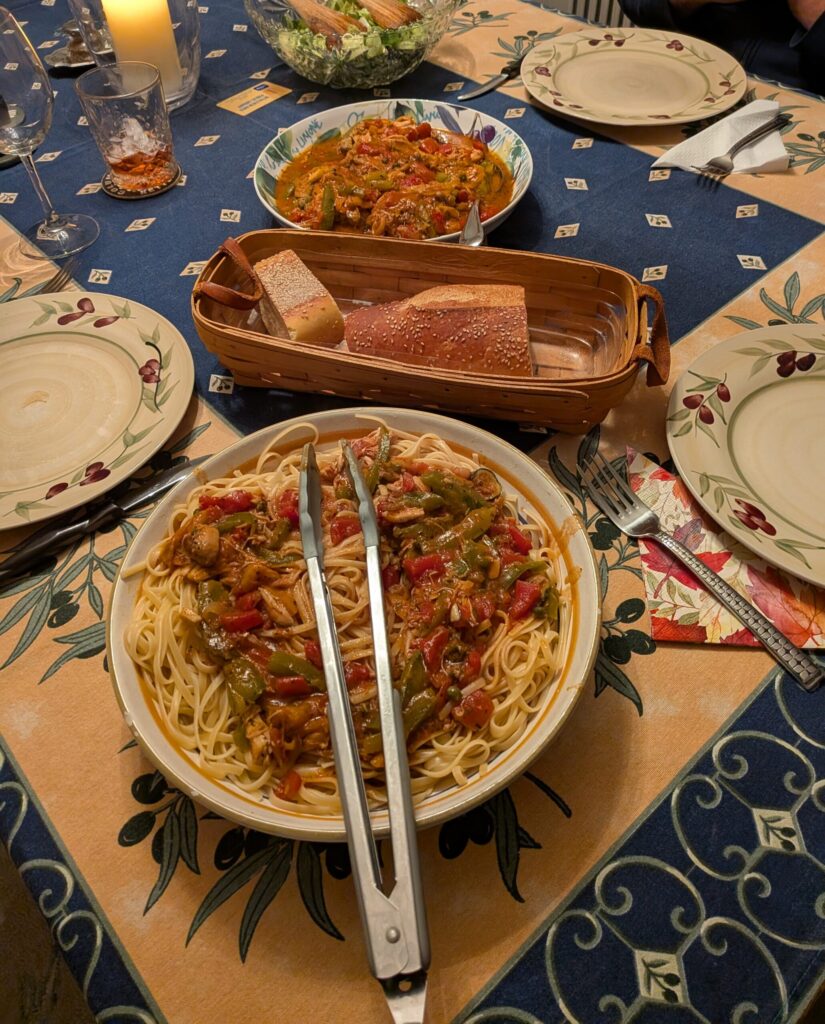
Michele made chicken cacciatore last night. Cacciatore (fem. cacciatrice) means “hunter” in Italian, so chicken cacciatore is “hunter’s chicken”.
But that’s not what my mother told me. When I was a boy she said chicken cacciatore meant “find the chicken!” It wasn’t until last night that I understood why she said that. I’m only speculating but I’m confident in saying that she learned it from her mother Maria. Maria raised eleven children, and I imagine her cacciatore was heavy on the tomatoes, peppers, and onions and rather light on the (more expensive) chicken. I can picture her telling the kids, “go ahead, hunt for the chicken, it’s in there!”
PS – Michele’s dish was not light on chicken, and it was delicious!
The following is a note that I sent to my extended family in June 2013, with comments in [brackets].
In May 2025, a change in Italian law made the path to citizenship more difficult. See this explanation.]
To my Pappalardo family –
This note is long overdue; my apologies. Many of you know that I have been pursuing my Italian citizenship, and some of you have expressed interest in doing the same. I will give you some information in this message, and will be happy to answer questions.
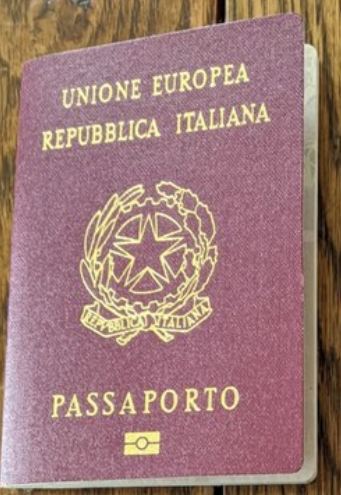
I am happy to say that both Michele and I have been recognized as Italian citizens, and our children Matt and Mary have been approved and are waiting for their registration to be completed. In fact, Michele and I obtained our Italian passports three weeks ago, just in time for our trip to Italy and France, which we just concluded.
Having those passports did not really make this trip any easier, [not quite true, the queue for Customs at Fiumicino is much shorter!] but there are definite benefits, among them the ability to live and work anywhere in the EU, something we have been considering for a few years. My desire for citizenship, however, goes beyond tangible benefits. It is more about affirming my connection to a land that I have come to love.
In fact, Italian citizenship is not something that I obtained. Rather, it is something that I have had since I was born. The process we completed merely recognizes this birthright. This is based on the principle of “jure sanguinis” (law of blood), which states that a person born to a citizen of Italy inherits citizenship, even if the birth takes place in another country.
For people born outside Italy, the key element is determining the citizenship of the parent.
Since the unification of the Kingdom (later the Republic) of Italy in 1861, Italian law stated that an Italian citizen who is naturalized in (i.e. becomes a citizen of) another country thereby forfeits his/her Italian citizenship, as does his/her children, both living and not yet born. In June of 1912, however, the law was modified: the forfeiture applied only to children not yet born.
For example, let’s say I emigrated from Italy to America with my Italian wife, who then bore a child. Later, my wife and I became US citizens. She then bore another child. Our first child would have Italian citizenship, while our second child would not. Both children would have American citizenship; i.e. the first child would be a dual citizen. Of course, any children born to the first child would also inherit citizenship of both countries, as would their children, and so on.
Anyone who can document this chain of citizenship can apply for recognition with the Italian consulate in whose jurisdiction they reside.
In order to establish my own claim, I needed to go back to my grandparents, all of whom were born in Italy. Note that until 1948, the above rule applied only to paternal bloodlines. As far as I know, tracing your bloodline to a mother, grandmother, etc. before that date will not get you anywhere. I am not sure about this however, since (happily) I did not have to pursue it. For me the search began and ended with my grandfather, Salvatore Pappalardo (aka “Pop”).
I first heard about this whole thing in 2009 from my friend Sean who, despite his first name, is very Italian. Our family and Sean’s family had just spent a wonderful week together in a villa in Radicondoli, near Siena. Michele and I had first visited Italy 24 years earlier. We had loved it then and this visit made us begin to think that we wanted to spend a lot of time there. (We have returned twice since then and hope to buy property one day.)
Sean mentioned this potential path to citizenship and I began to look into it. I knew that Pop had become a US citizen, but I didn’t know whether that occurred before or after the birth of my father in 1908. I asked Cousin Peggy (who had done quite a bit of family genealogy) if she knew anything. She said she had seen a handwritten note indicating that Pop was naturalized in 1910. If this were true, then I was indeed an Italian citizen.
The first step was to obtain proof of the naturalization date. This is typically done by contacting the US Department of Immigration and Naturalization. Once this document was procured, I would then need certificates of birth, marriage and death for my grandparents, parents and myself.
At this time other things in my life took my attention, and time went by. Then one day in the spring of 2011, while rummaging through the old desk my mother had given me years before, Michele came across Pop’s actual, original Certificate of Naturalization, dated 1910.
Excited by this discovery and my good fortune in being able to skip the first step, I began working in earnest. I found and joined an Internet forum devoted to the subject [https://www.tapatalk.com/groups/italiancitizenship/] and called to make an appointment with the Italian Consulate in Philadelphia. They scheduled me for the earliest date available, in November 2012, a year and a half away!
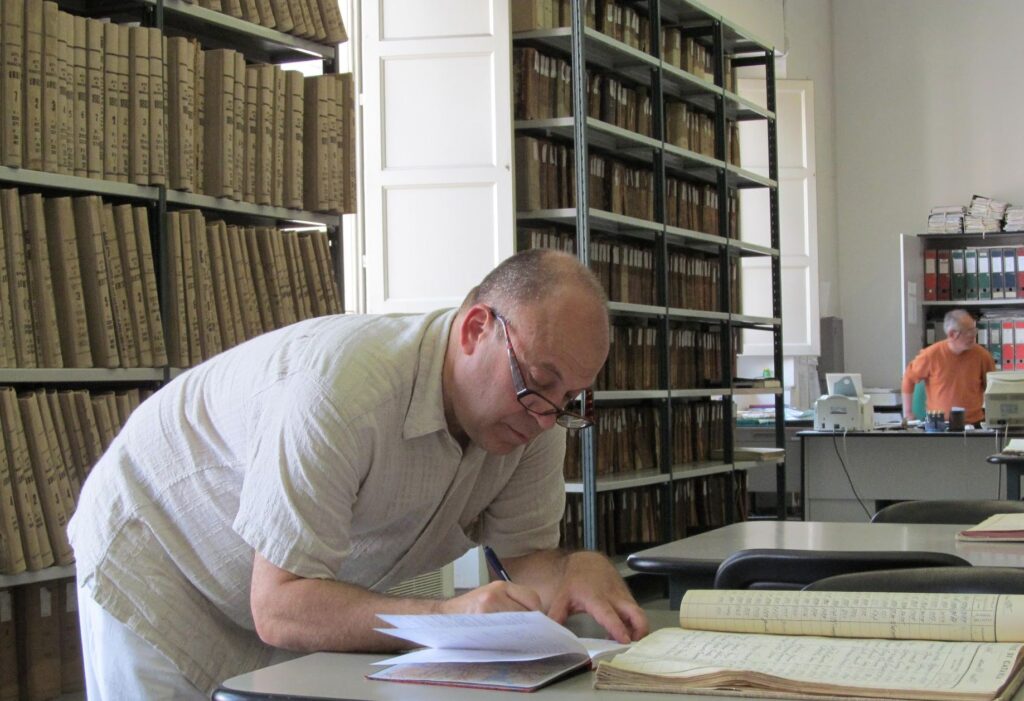
While it meant a long wait, it also gave me time to get all of the paperwork. As it turned out, they called several months later to offer me an earlier appointment, in July 2012. I took the offer and barely had enough time to prepare. There were some anxious moments, and a crazy trip to the Office of Archives in Catania (Sicily) along the way, but in the end my application, as well as Michele’s (by virtue of marriage) was approved.
By now some of you no doubt are wondering if and how you can pursue Italian citizenship. Here are some important points:
Pop and his wife Santa had six children. The eldest five were born before Pop naturalized, but the youngest, Joe, was born after that. So unfortunately, Joe’s children, grandchildren, etc., are not eligible to apply for citizenship. At least, not jure sanguinis through Pop. (There are other ways to establish citizenship, but I can’t advise on those.) Sorry, my cousins 🙁
If you want to apply through the Philadelphia Consulate, you can “piggyback” off of my file. [My brother Pete succeeded in doing this, but a few years later one of my nieces was told that she could not.] That is, you need only enough documents to connect yourself to the branch I have already established. That’s how Matt and Mary made their applications; they needed only their own birth certificates. Just let me know!
The consulate is very particular. You will need official, original documents with apostilles and translations. You can learn all about it on the forum(s).
I am happy to talk about all of this and more, including my wonderful wife’s ideas of family reunions, vacation rentals and opening a travel business.